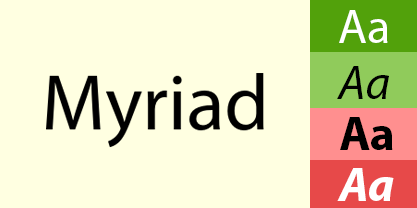
Released in 1992 as an Adobe Originals design, Myriad has gained popularity for both text and display applications.
The OpenType release, Myriad Pro, expands the sans-serif family by incorporating Greek and Cyrillic characters, introducing oldstyle figures, and enhancing support for Latin-based languages.
The complete Myriad Pro family encompasses condensed, normal, and extended widths across a full spectrum of weights.
Designed by Robert Slimbach, Carol Twombly, Fred Brady, and Christopher Slye, Myriad combines warmth and readability through humanistic letter proportions and detailed design elements.
Myriad Pro stands out with its clean, open shapes, precise letter spacing, and extensive kerning pairs, making it a unified family suitable for comfortable text typography.
Additionally, the wide array of weights and widths in this family provides a versatile creative toolkit for demanding display typography.
The design of Myriad is patent-pending.
Robert Slimbach
Carol Twombly
John Warnock and Chuck Geschke founded Adobe Systems in San Jose, California in 1982. The company turned into a billion-dollar business in 1999, thanks to its wide range of applications for images and text handling, as well as a high-quality type library. Their rise to prominence is largely due to the PostScript graphics programming language which has been a printing industry standard since the mid-1980s. Adobe Illustrator and Photoshop have been fundamental tools in the graphic design industry for many years. Adobe also introduced the PDF format for document exchange, another standard in the industry. In 1990, Adobe Type Manager (ATM) was launched, which allowed for on-screen font rendering.
※ 아래 라이센스 표는 참고용입니다.
폰트 제작사의 규정에 따라 사용범위의 변동이 있을 수 있으므로 정확한 사용범위는 폰트 제작사에 확인하시기 바랍니다.
Desktop: for use on desktop workstations in applications with font menus. Includes creating and printing documents and static images. Limits apply based on user quantity and use in logos/trademarks.
Electronic Doc: allows font embedding in electronic publications. Each publication issue counts as separate use, with some allowances for updates and variations.
Digital Ad/Email: for embedding fonts in digital ads like HTML5 banners. Terms enable use in ads and ad networks. Prices are based on ad impressions with options for adjustment.
Webfont: for use on a single domain, not shareable across multiple sites. Usage is counted per pageview including the font kit. License types vary: Annual, Pay Once, or Pay As You Go.
App: for embedding fonts in mobile applications, with each app requiring its unique license. Applies to apps on iOS, Android, or Windows Phone.
| Category | Scope of Use | Permission |
|---|---|---|
| Desktop | Desktop applications, Document creation, Image production | X |
| Electronic Doc | eBooks, eMagazines, eNewspapers, interactive PDFs | X |
| Digital Ad/Email | HTML5 digital ads, advertising networks | X |
| Webfont | Websites on a single domain | X |
| App | Mobile applications | X |